I love the Average True Range (ATR) indicator.
Because unlike other trading indicators that measure momentum, trend direction, overbought levels, and etc.
The ATR indicator is none of it.
Instead, it’s something entirely different.
And if used correctly, the Average True Range is one of the most powerful indicators you’ll come across.
That’s why I’ve written this post to explain the awesomeness of the Average True Range indicator.
Here’s what you’ll learn:
- What is the Average True Range (ATR) indicator and how does it work
- How to “hunt” for EXPLOSIVE moves in the market before it occurs using the ATR indicator
- How to use the ATR indicator and set a proper stop loss so you don’t get stopped out prematurely
- How to use the ATR indicator and ride BIG trends
- Using ATR to set profit target
- How to identify “exhaustion” moves and market reversals with the ATR indicator

JOIN OVER 10,000 TRADERS NOW
ATR indicator explained — what is it and how does it work
Let’s start with the basics:
What is ATR?
The Average True Range is an indicator that measures volatility.
It’s developed by J. Welles Wilder and was first mentioned in his book, New Concepts in Technical Analysis Systems (in 1978).
Now you might be wondering:
“How is the ATR values calculated?”
Well, it’s done using 1 of 3 methods, depending on how the candles are formed.
Here’s how…
Method 1: Current high less the current low
Method 2: Current high less the previous close
Method 3: Current low less the previous close
Confused?
No worries, just look at the image below…

As you can see:
Example A: The current candle’s range is larger than the previous candle, we use method 1.
Example B: The current candle closes higher than the previous candle, we use method 2.
Example C: The current candle closes lower than the previous candle, we use method 3.
The takeaway is this…
The larger the range of the candles, the greater the ATR value (and vice versa).
Now before we continue, do you still remember what is ATR?
That’s right.
Average True Range.
So remember it as we proceed to the next section!
The ATR indicator is NOT a trending indicator
Now…
A mistake traders make in how to use ATR is to assume that volatility and trend go in the same direction.
Nope!
Recall:
The Average True Range indicator measures the volatility of the market.
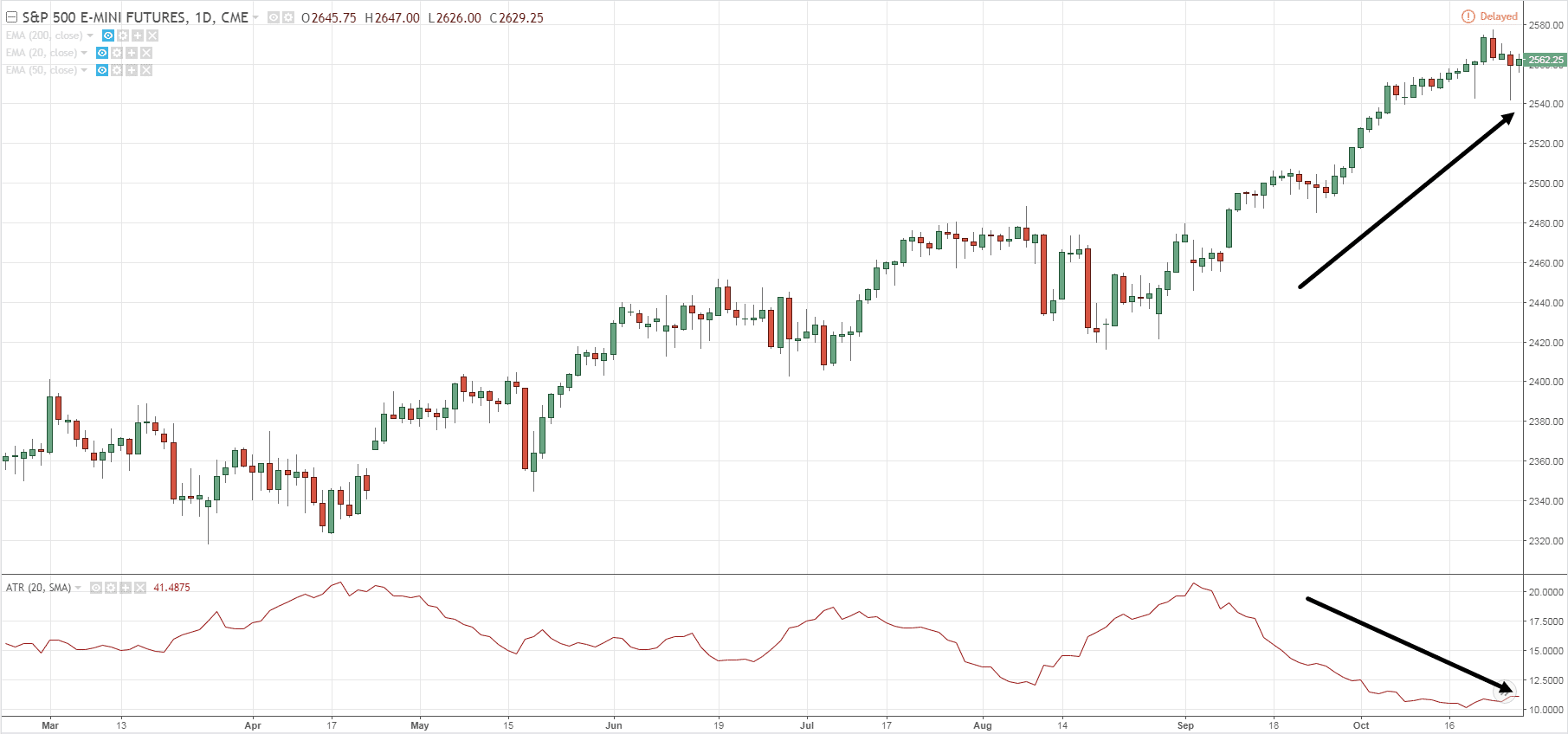
This means volatility can be low while the market is trending higher (and vice versa).
Here’s an example: The S&P is trending higher while volatility is heading lower…
Does it make sense?
Good.
Then let’s move on…
How to use ATR indicator to “hunt” for EXPLOSIVE breakout trades (before it occurs)
Here’s a fact:
The volatility of the markets is always changing.
It moves from a period of low volatility to high volatility (and vice versa).
This means that when the market is in a low volatility period… you can expect volatility to pick up, soon.
So, how do you use this knowledge to find explosive breakout trades for ATR trading before it occurs?
Here’s how…
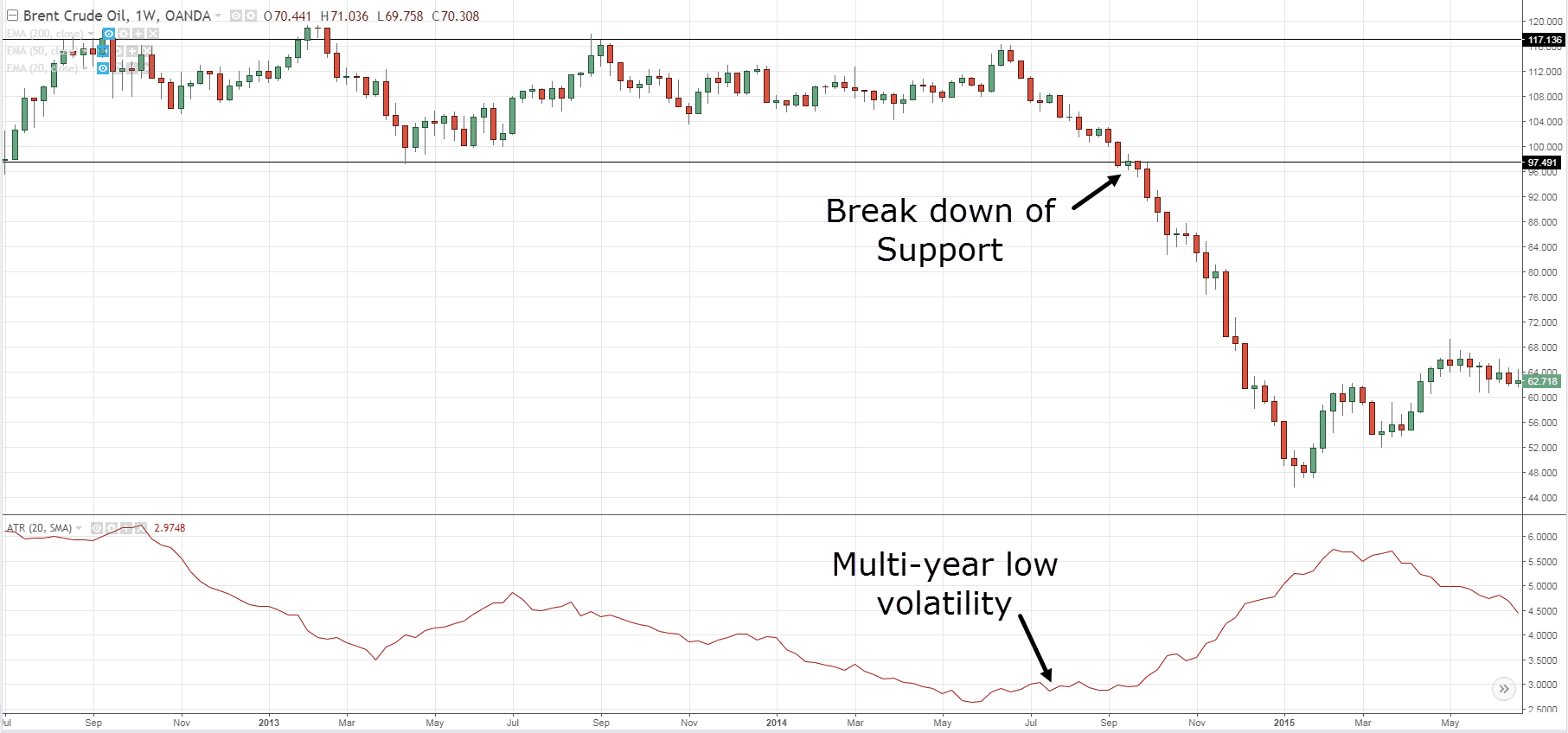
- Wait for volatility to reach multi-year lows (on the weekly timeframe)
- Identify the range during this time period
- Trade the break of the range
Here are a few examples:
Brent Crude Oil multi-year low volatility followed by a break of Support…
EURUSD multi-year low volatility followed by a break of Support…
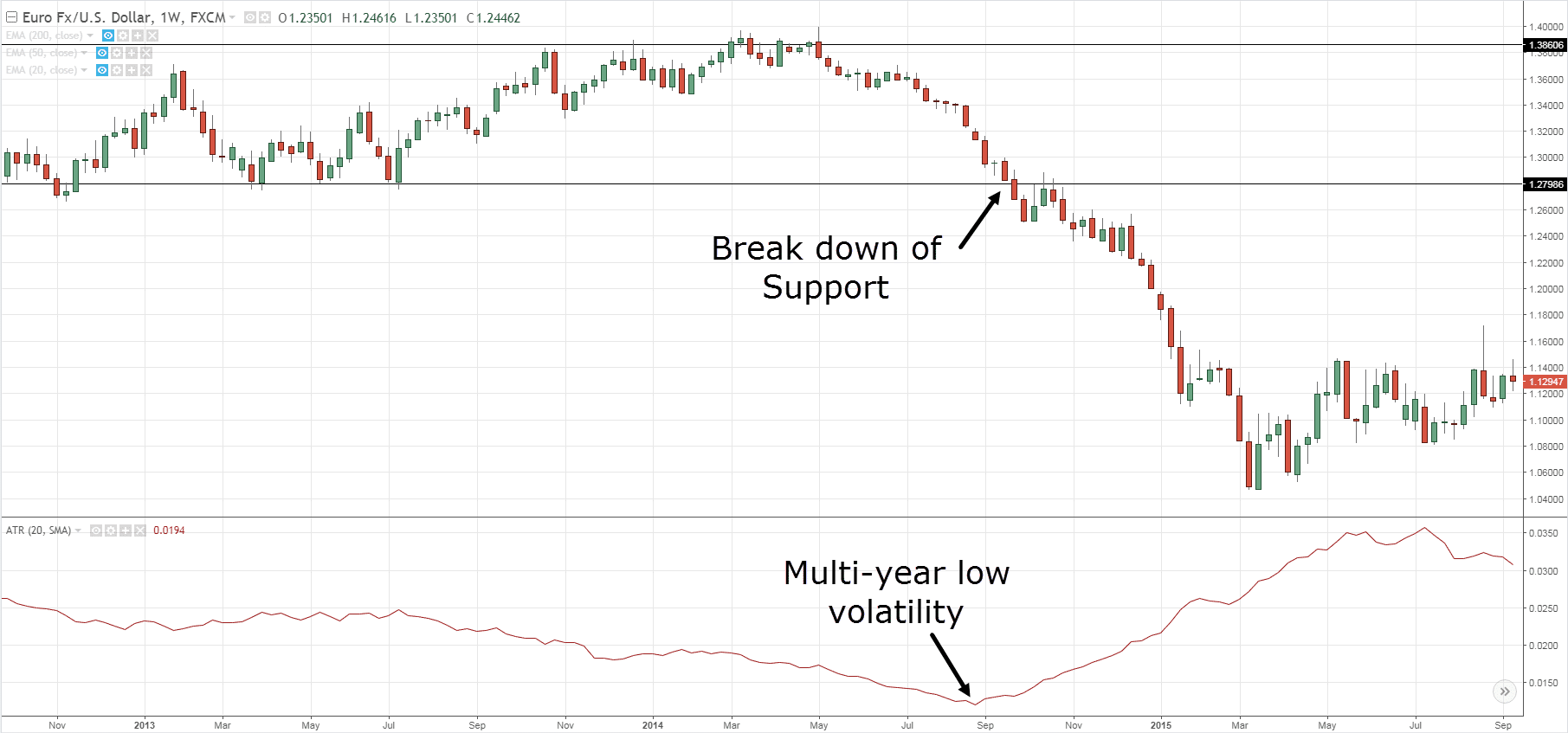
Do you notice how these explosive moves occur after a period of low volatility?
Pretty cool, right?
This is a hidden technique on how to use ATR.
Are you sick of getting stopped out of your trades prematurely? Here’s how to fix it…
Let me ask you…
Have you ever put on a trade only to watch the market hit your stop loss, and then continue moving in your expected direction?
It sucks, right?
And that’s because your stop loss is “too tight”.
So, what’s the solution?
Give your trade room to breathe.
This means your stop loss should be wide enough to accommodate the daily swings of the market.
Now you’re probably wondering:
“But how much is wide enough?”
“How to use ATR to improve my stop loss objectively, will it actually help?”
Well, here’s how you can use the ATR indicator to help you with it…
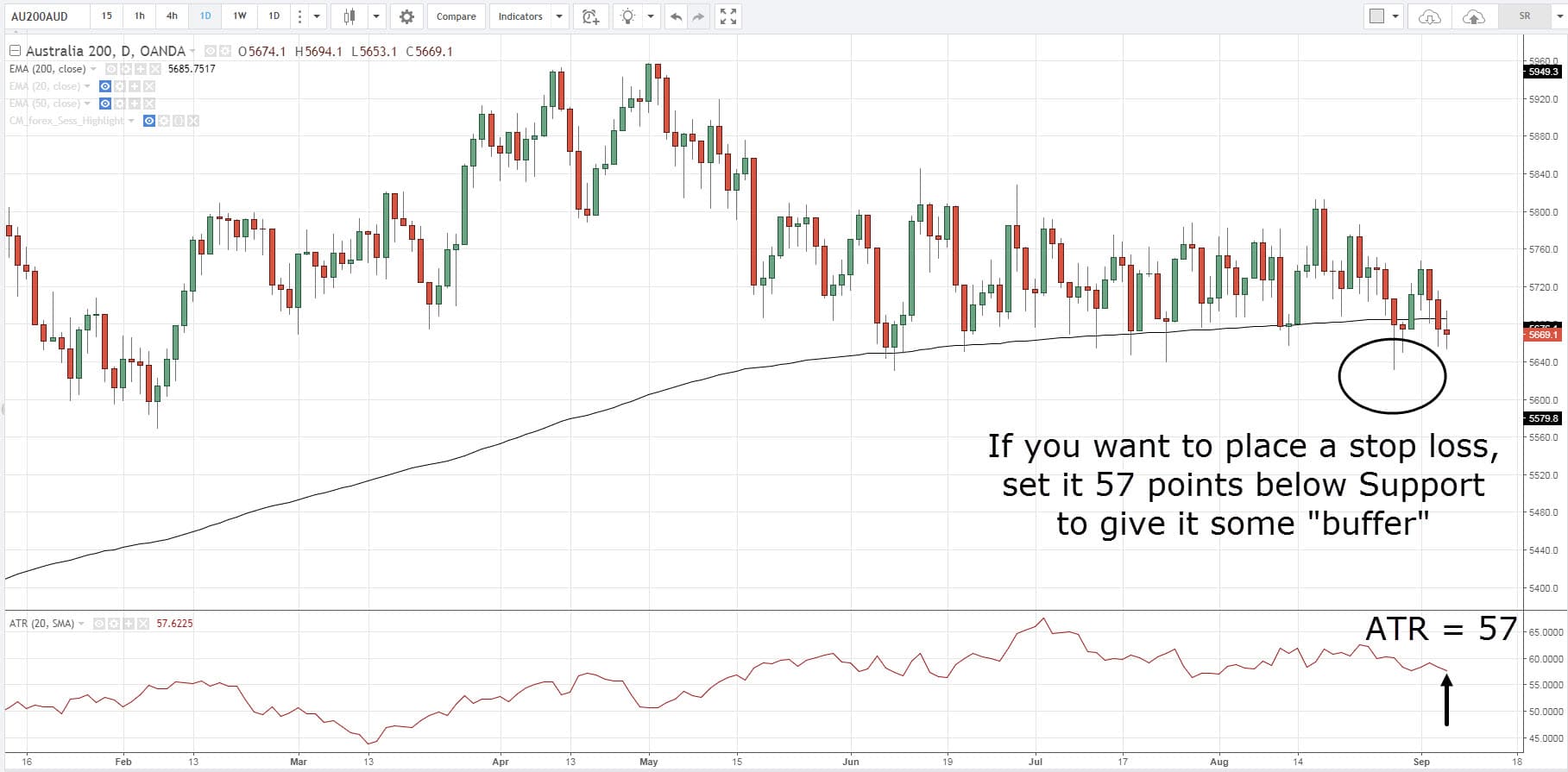
- Find out what’s the current ATR value
- Select a multiple of the ATR value
- Add that amount to nearest Support & Resistance level
So…
If you are long from Support and have a multiple of 1, then set your stop loss 1ATR below the lows of Support.
Or if you’re short from Resistance, and have a multiple of 2 then set your stop loss 2ATR above the highs of Resistance.
An example:
How to use the ATR indicator and ride BIG trends
Here’s the thing:
If you want to ride massive trends in the markets, you must use a trailing stop loss on your trades.
The question is… how?
There are many ways to do it, but one of the popular methods is to use the ATR indicator to trail your stop loss.
Here’s how…
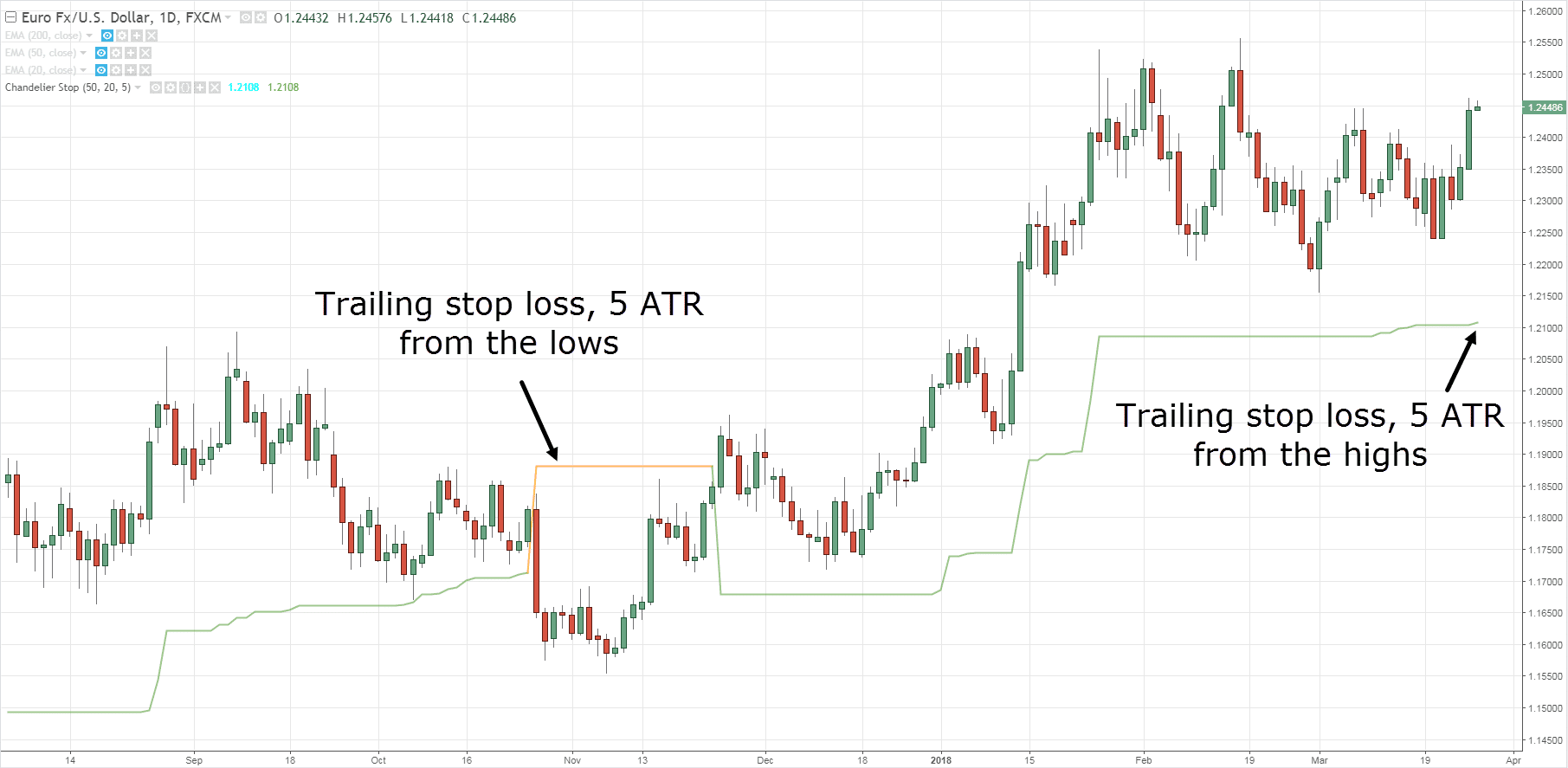
- Decide on the ATR multiple you’ll use (whether it’s 3, 4, 5 and etc.)
- If you’re long, then minus X ATR from the highs and that’s your trailing stop loss
- If you’re short, then add X ATR from the lows and that’s your trailing stop loss
And to make your life easier, there’s a useful indicator called “Chandelier stops” which performs this function.
Here’s an example of the 5ATR as a trailing stop loss:
Now you’re probably wondering:
“So Rayner, which is the best ATR multiple to use?”
Well, the truth is… there’s no best ATR multiple.
If you use a smaller ATR multiple, then you’ll ride a small trend (and the time held on the trade is shorter).
If you use a bigger ATR multiple, then you’ll ride a bigger trend (and the time held on the trade is longer).
So which approach suits you best?
Only you can answer that question yourself.
Moving on…
Using ATR to set profit target, here’s how it works…
Now if you don’t want to ride trends, you can also use the ATR indicator to set a target profit.
Here’s how it works…
You know the ATR indicator tells you how much a market can potentially move for the day.
So…
If EUR/USD has a daily ATR of 100 pips, it moves an average of 100 pips a day.
This means if you’re a day trader, you can have a target profit of about 100 pips (give and take) and there’s a good chance it’ll be hit.
Of course, you don’t want to “blindly” set a 100 pips target profit.
Instead, combine it with market structure (like Support & Resistance, swing high & low, etc.) so you know where the price might reach for the day.
Here’s an example:
Let’s say EUR/USD moves an average of 100 pips a day, again.
You went long at support and you’re not sure where to take profits.
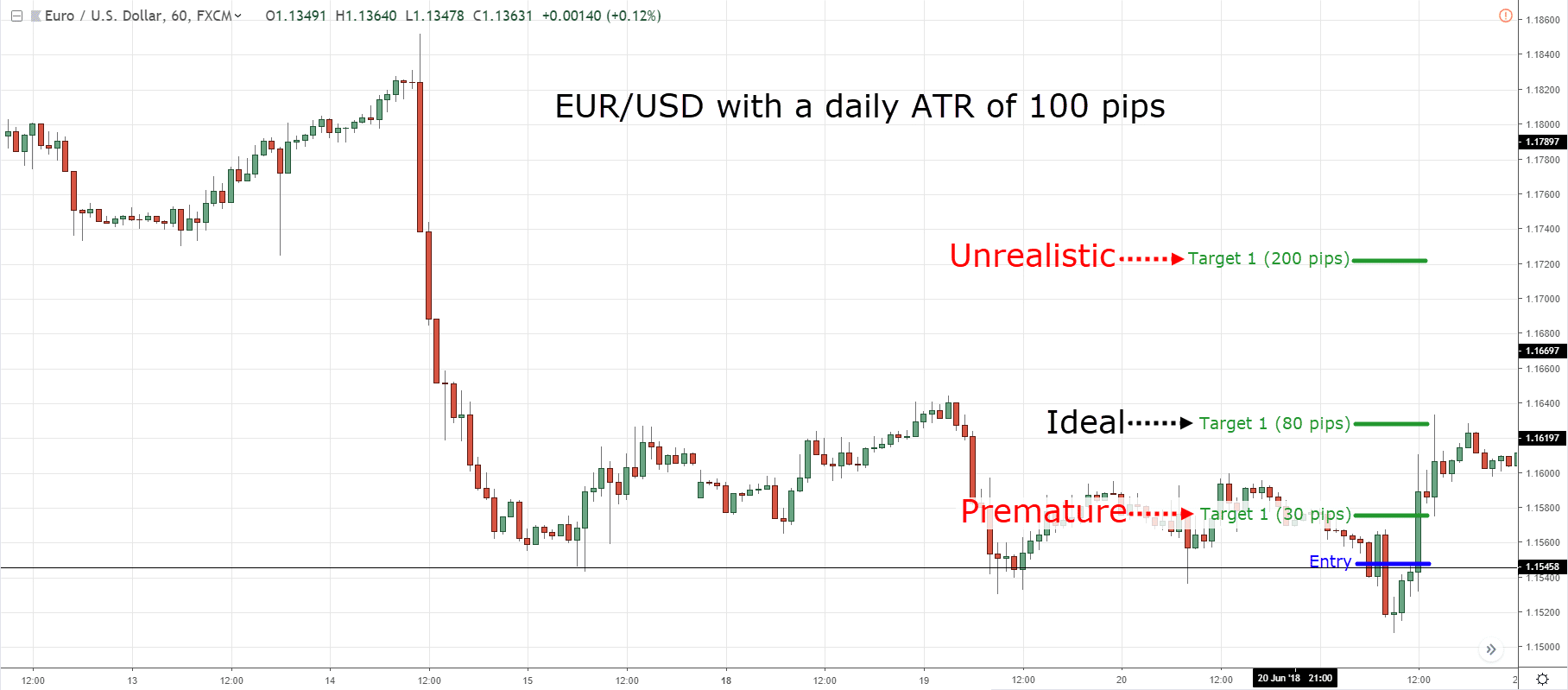
There are 3 possible Resistance levels: 30 pips away, 80 pips away, and 200 pips away.
Which do you choose?
The 30 pips target is likely to be hit within a day but you’re leaving money on the table as the market could move 100 pips a day.
The 200 pips target is unlikely to be hit within a day (as it’s more than the ATR value).
The 80 pips target is your best option as it’s within the daily ATR value (and offers more than 30 pips).
Here’s what I mean…
Three possible targets on EUR/USD 1-hour:
So here’s the takeaway…
- Identify the daily ATR value
- When you set your profit target, combine it with market structure and ensure the distance is less than the daily ATR value
Pro Tip:
If you trade longer-term, you can refer the weekly or monthly ATR value.
Next…
How to find “exhaustion” moves and time market reversals
I’m sure you agree nobody can work “forever” without exhaustion.
After an hour or so, most of us will need a break to recharge.
But wait.
Why am I telling you this?
Because the market is just like you, it can only “work” for so long before taking a break.
This means there’s a good probability the market will “exhaust” itself after hitting its limits.
Now you might be wondering…
“How do you tell what’s the limit?”
Well, you can find out using the Average True Range indicator.
Here’s how…
- Identify the current ATR value
- Multiply it by 2
- If the market moves 2 times the ATR value, then it could be “exhausted”
Now, I don’t suggest you trade this concept in isolation.
Instead, combine it with Support & Resistance and you’ll find yourself identifying market reversals ahead of anyone else.
Here’s an example: GBPJPY has a weekly ATR value of 300 pips…
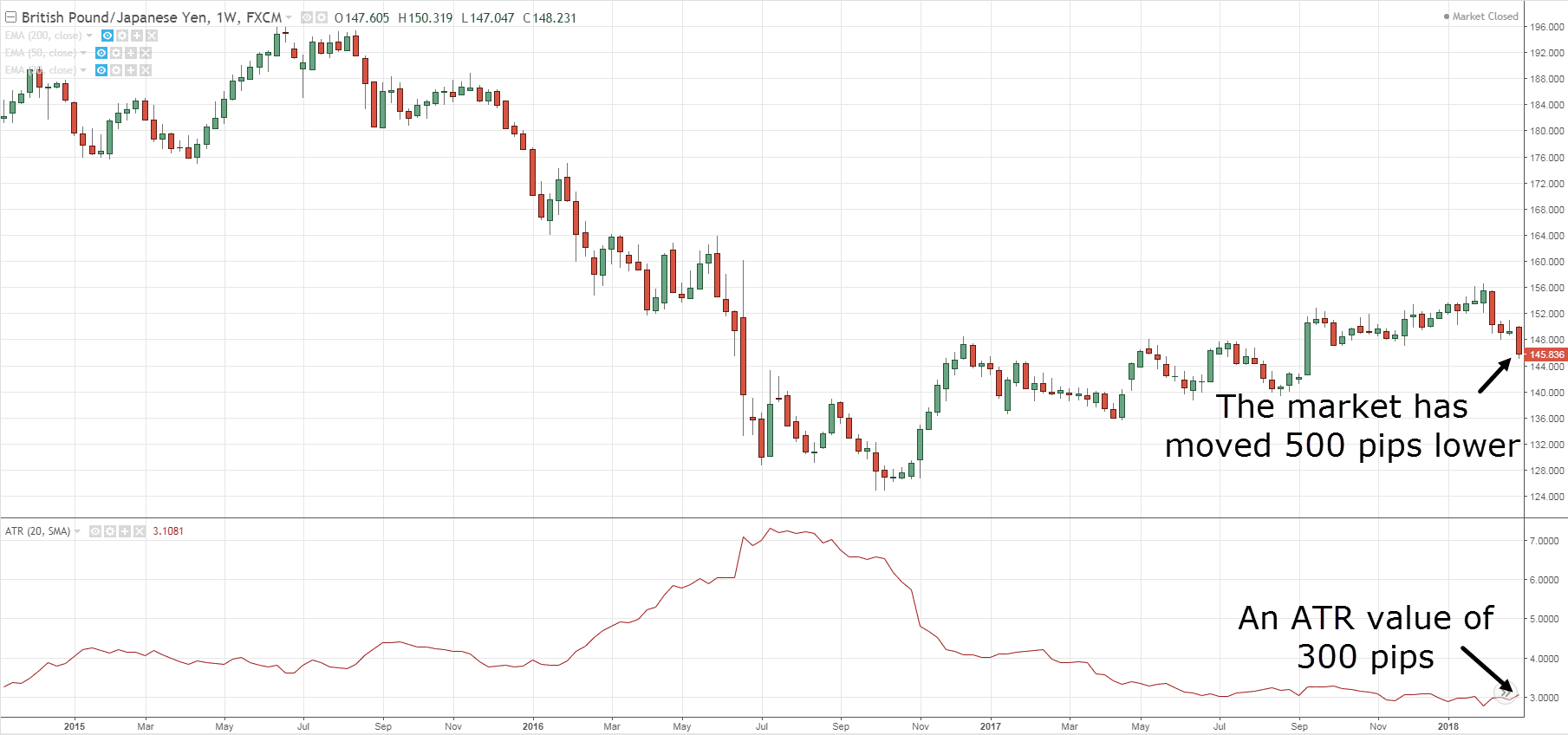
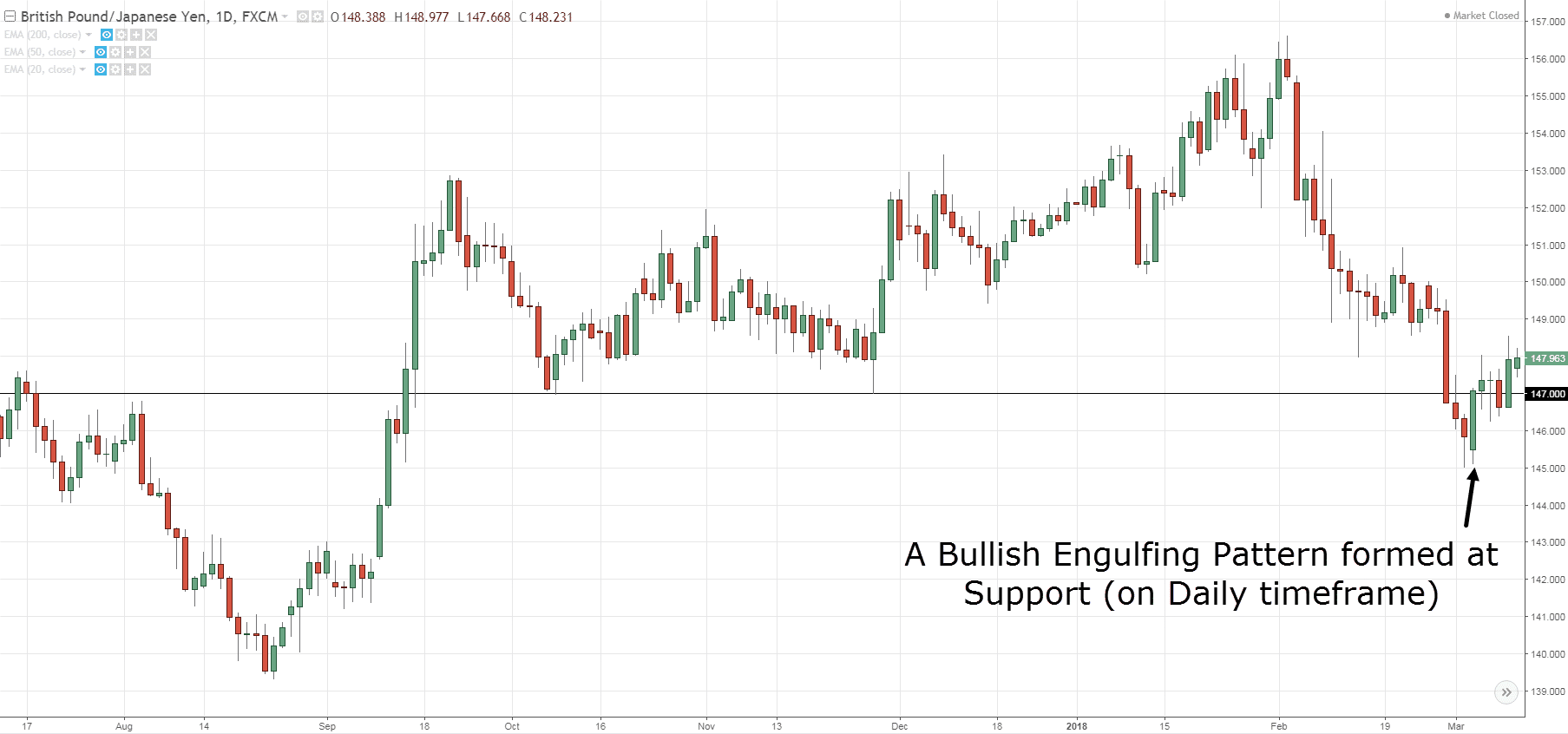
And now, you realized GBPJPY has moved 500 pips (close to 2ATR) and it came into an area of Support.
Then, it forms a large Bullish Engulfing pattern on the Daily timeframe.
Now… what do you think will happen?
Well, I can’t say for sure.
But you have an “exhaustion” move, the price coming into an area of Support, and a Bullish candlestick pattern that signals the market could reverse higher.
Conclusion
Here’s what you’ve learned:
- The Average True Range (ATR) is an indicator that measures the volatility of the market
- You can use the ATR indicator to identify multi-year low volatility because it can lead to explosive breakout trades
- You can set your stop loss 1 ATR away from Support & Resistance so you don’t get stopped out prematurely
- If you want to ride a trend, you can trail your stop loss X ATR away from the highs/lows
- When the market hits 2 ATR or more within a day, it tends to be “exhausted” and could reverse
Now here’s my question for you…
How do you use the Average True Range indicator?
Leave a comment below and let me know your thoughts.
JOIN OVER 10,000 TRADERS NOW
When you’re ready, here are 3 ways I can help you…